
|
Glasses
Because
glasses lack long-range translational
order, standard diffraction techniques
are limited for structural studies.
Nuclear magnetic resonance spectroscopy
is an isotope-specific method which
provides valuable information about
short-range structure. Many NMR
techniques have been developed to obtain
high-resolution spectral data in
glasses, from which useful structural
parameters can be
obtained.
Borate and borosilicate
glasses are the primary targets of our
glass research, largely because of their
importance in a variety of applications
ranging from everyday cookware to
nuclear waste disposal. Structural
information obtained by NMR is
correlated with the properties of
relevance for particular applications to
develop relations which can improve
materials properties.
Transition-Metal Cyanides
ince
the discovery of Prussian Blue in 1704,
metal cyanides have attracted attention
for their many interesting properties
and vast diversity. Much of the recent
interest in these materials is related
to their framework structures and
catalytic potential. However, structures
can be difficult to determine using
x-ray crystallography, especially when
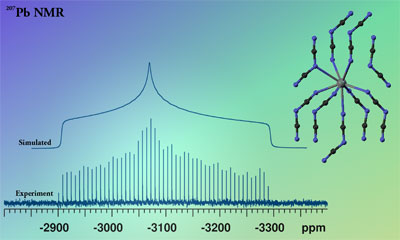
dynamics are present. We use NMR to gain
insight into structure and dynamics in a
wide variety of transition-metal
cyanides
Many of the materials of
interest contain stoichiometric amounts
of paramagnetic ions, which presents a
challenge to NMR studies. Our recent
work investigates the feasibilty of NMR
for the structural characterization of
paramagnetic solids.
 
|